









Some email marketing platforms might miss the features you need. Others could be all glitter and dazzle, meaning fancy add-ons you won’t use but will pay a lot for. To save you from a never-ending scavenger hunt, we’ve rounded up the top email services based on their key features and pricing.
Now, grab your coffee and let’s find a platform that suits you. Because life is too short to spend it arguing with screwdrivers.
1. Moosend
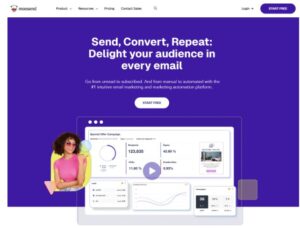
Moosend is the email platform where the impossible becomes reality: affordable, yet powerful enough to turn campaign chaos into a marketing cash cow (pun intended). It offers advanced tools to design, personalize, and automate emails without milking their budget dry. OK, enough with cow references.
Now, if you’re worried you’ll get lost in the Bermuda Triangle of a user-hostile interface, desperate to find the right feature, that’s not the case with this platform . Moosend’s interface is clean, with robust tools and a shallow learning curve so you start sending beautiful emails from day one.
You get access to professionally-designed email templates and a drag-and-drop email builder intuitive enough that makes moving around videos, images, or product blocks feel like playing Tetris. Plus, automation with Moosend is beginner-friendly so you can easily set up behavioral-triggered workflows with conditional logic without calling in a coding expert.
As for AI? The platform gives you writing tools to nail your email content. Whether you need fresh ideas or just a different tone of voice, Moosend’s AI writer can create emails that stand out in a few clicks.
You’ll also find ready-made segments and custom fields to group your contacts. Dynamic content blocks let you personalize messages based on each recipient’s history and interests, so you can make them an offer they can’t refuse.
The best part is that you won’t have to break the bank to afford all these tools. Moosend is known for being a cost-effective email platform with flexible pricing, which makes it a top choice for small business email marketing, startups, solopreneurs, and any budget-conscious business.
Best features:
- Drag-and-drop email editor
- Pre-built email templates
- AI writer
- Customizable workflow recipes
- Landing pages and signup forms
- Transactional emails
- Great deliverability
- Real-time email analytics
- No sending limit on all plans
Pricing:
Moosend’s pricing starts at $9/month, including unlimited emails, email automation, and lead generation. Like paying for Netflix but getting more value back. Although there’s no free version, the 30-day free trial is enough to test all core features.
2. Constant Contact

Constant Contact is the black dress of email marketing automation. It’s not flashy or super-trendy, but it’s classy, easy on the eye, and never goes out of style.
With this email marketing solution, you won’t find yourself asking “Where did they hide that feature/ setting/ you-name-it?” Constant Contact’s interface works like a compass, guiding you through simple but reliable tools.
We all want to build campaigns with ease. This email platform makes it possible with an editor that turns email creation into a piece of cake so you can dive into the actual cake. And with over 600 stunning templates, your campaigns will belong in Vogue instead of 2010.
The BrandKit feature allows you to create and lock template sections. That way, you won’t risk someone from your team turning your amazing designs into a Comic Sans MS nightmare full of weird-looking stock photos.
If your products and services are too awesome to live only in emails, Constant Contact also offers SMS and social media marketing to help you spread the word. Moreover, marketers can leverage its event marketing capabilities to organize and promote events, from the first email invite to the personalized follow-up.
As for lead capturing, Constant Contact has it all: landing pages, signup forms, paid ads, plus a Lead Magnet feature to lure people onto your list . Where the platform falls behind is email automation, which feels rather simple compared to its more advanced competitors.
Best features:
- User-friendly editor
- Huge email template library
- BrandKit for consistent branding across campaigns
- Multichannel marketing options (email, SMS, social media)
- Lead generation tools
- Event management
- Top-notch deliverability
Pricing:
Constant Contact’s pricing starts at $12, offering access to email templates, contact management, and an AI copy generator. You can sign up for the 14-day free trial to explore some of the platform’s features before choosing a paid plan.
3. HubSpot

HubSpot is that kid who aced every exam, spoke three languages, played two instruments, and launched a startup before turning 18. It’s powerful, efficient, and slightly intimidating.
It’s a robust email marketing service that offers free and paid tools for marketing, sales, and customer service. With it, you can create and send emails, automate communication, run social media campaigns, and manage paid ads. All without jumping from one tool to the next like your cat does when chasing imaginary enemies in the garden.
The flexible email editor lets you add content blocks and adjust the design of a ready-made design without touching a single line of code, worrying about breaking the whole thing. And if you’re having a “my brain is empty but my content calendar isn’t” moment, the platform’s AI helps you craft branded, personalized emails in minutes.
When it comes to growing your email list, the platform offers signup forms, retargeting ads, and landing pages to help you reach a wide audience. Where it goes wild, though, is its integrated CRM, which centralizes data from emails, customer service interactions, and website activity. If you’re using a high-priced plan (Professional and above), you unlock omnichannel automation, including social media and SMS campaigns.
Overall, HubSpot is a great choice if you’re willing to pay more to keep everything under one roof. But if all you need is to send newsletters, it’s like hiring a private jet just to pick up your mom’s casserole from the next block.
Best features:
- Intuitive email builder
- Omnichannel automation workflows
- Built-in CRM
- Lead scoring
- SMS and social media marketing
- List growth tools
- A/B testing
Pricing:
HubSpot’s free version is a good option for small teams with simple needs, offering a CRM, AI content creation, and email templates (limited). The Starter plan costs $20/month for 1,000 subscribers, basic automation, and retargeting ads.
4. Mailchimp

Next on our list comes the Chimp of all trades. Mailchimp is a platform that performs well in email marketing but also lets you engage with customers on multiple channels, such as social media and SMS. Did we mention you can build a website for free? Yes, throw that in, too.
When it comes to email creation, you can use the new builder and a ready-made template to build a visually appealing campaign. Alternatively, the platform’s legacy builder lets you code your own emails if you enjoy HTML (we don’t judge).
To create personalized paths across channels, Mailchimp provides a Customer Journey builder that helps deliver the right message at the right time. You can also use workflows to automatically tag or untag recipients and move them into the most suitable segment.
The powerful AI Content Optimizer checks emails for broken links and errors so you won’t ask subscribers to “click hear” or something equally embarrassing.
Mailchimp is the equivalent of a Friends rerun. You’ve heard most of your peers talking about it, so it must be the coolest kid in town, right? That said, you might go bananas when you see its contact-based pricing which charges for unsubscribed and duplicate contacts. Or when you get excited about a feature, only to realize it’s only available on a plan you can’t pay for.
Best features:
- Drag-and-drop email builder
- Variety of modern email templates
- Integrated CRM
- Visual customer journey builder
- Transactional emails offered as an add-on
- Lead generation tools (e.g., pop-ups, paid ads)
- Free website builder
Pricing:
Mailchimp’s pricing starts at $13/month, with email templates, lead generation, and basic reporting. For those getting started, you can use the free plan to test a few basic tools. If you want more, walk with caution because the pricing logic might make you seriously question your life choices.
5. ActiveCampaign

ActiveCampaign is the friend who takes charge of everything: concert tickets, hotel bookings, even your gym subscription renewal. Like that friend, it manages your email campaigns, marketing automation, content creation, and customer relationships.
The drag-and-drop email designer makes email creation a breeze, while you can easily tailor campaigns to your branding through a bit of AI magic. But ActiveCampaign likes to show off, so its AI functionality goes beyond that, covering content generation and translation, segment creation, and send time optimization.
Now let’s focus on what ActiveCampaign is mostly about. This all-in-one marketing platform is the Holy Mail for brands that take automation seriously. It excels at building highly targeted and detailed workflows triggered by nearly anything. Think purchases, webinar attendance, chat interactions, page views, mood swings. OK, we made the last one up, but you never know.
With that level of automation, segmentation needs to be granular. And it is, thanks to the software’s powerful CRM, allowing you to track every customer interaction and see where every lead stands in the revenue pipeline.
So it’s all roses and sunshine, at least until the monthly invoice comes in. ActiveCampaign is worth it, but the price tag is high, especially since advanced features like content generation or dynamic content are locked behind expensive plans. Also, there’s a steep learning curve involved, so don’t expect to master its tools from day one.
Best features:
- Easy-to-use email builder
- Advanced multichannel automation
- More than 1,000 (yes, that’s the number) workflow recipes
- Granular audience segmentation
- Built-in CRM
- Transactional emails
- AI-driven content for emails, landing pages, social media posts, and SMS
Pricing:
ActiveCampaign’s Starter plan costs $19/month for 1,000 contacts and access to email templates, automated recipes, but limited segmentation and personalization. You can always test some of its features through the 14-day free trial.
Pick your Dream Email Marketing Platform
These are the five stars of email marketing. You shouldn’t count on impressive features and unrealistic expectations to make a choice. Instead, choose the email platform that meets your current needs while keeping future ones in mind, too.
Play around with the free version or trial to check what’s included, what’s locked, and how steep the learning curve feels after using the tool, not watching a demo. Whether it’s the user-friendly power of Moosend or the simple elegance of Constant Contact, the right solution should turn email marketing into a stroll, not a chore.
So take your pick and let the tool do the heavy lifting while you finish your coffee and your IKEA little helper is busy elsewhere.